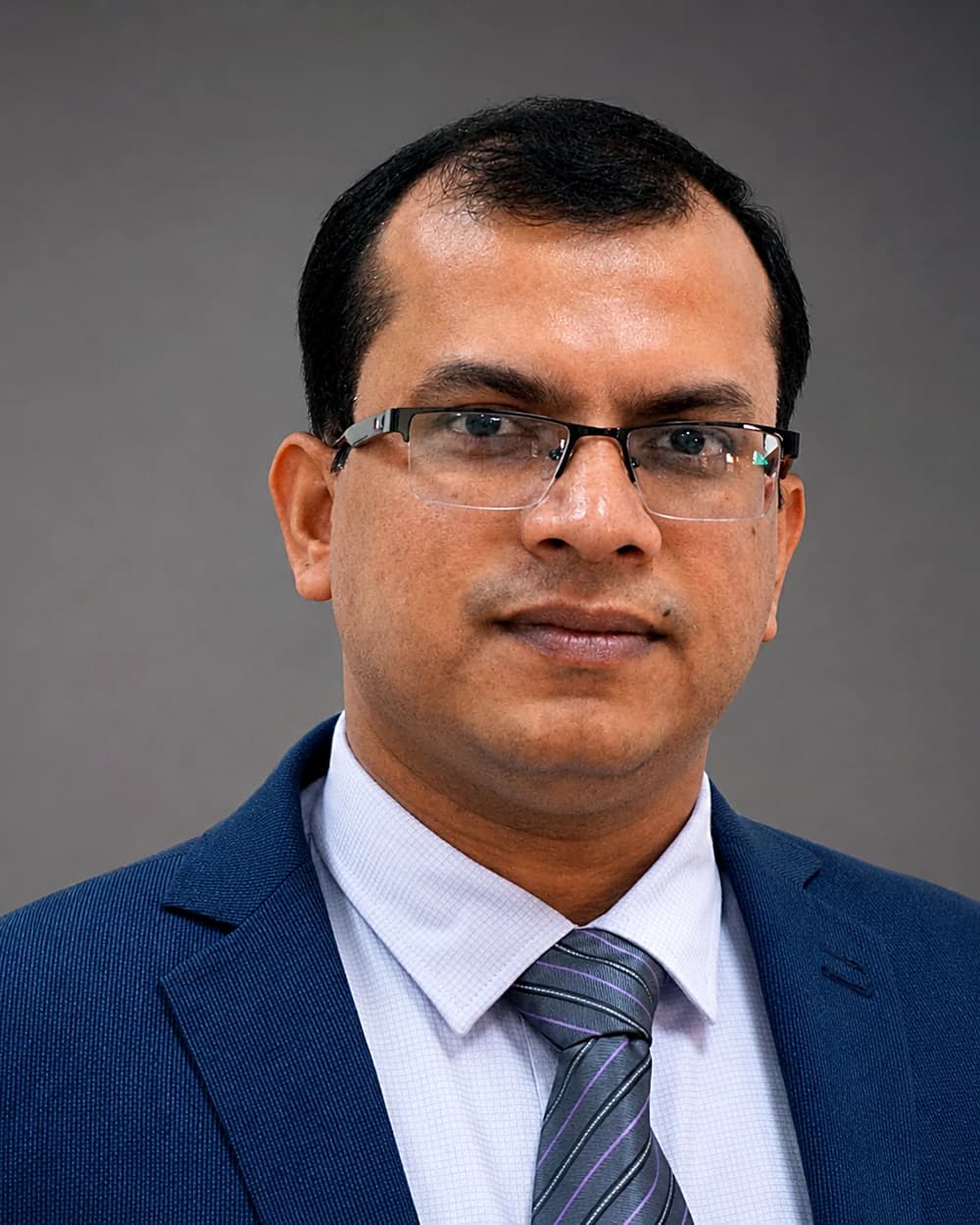
Mohammed Shamsul Arifin
I build the systems that decide whether training actually leads to work
Based in Bonn, working wherever the ministry, the classroom or the donor needs me to be.
Twenty six years into this work, the pattern is still the same. A country has ambition, a donor has funding, a ministry has a plan, and none of it moves until someone sits down and makes the pieces fit together. That has been my job across Germany, Bangladesh, Sudan, Afghanistan, Saudi Arabia and Zambia: turning skills strategy into something a young electrician, a returning refugee or a national exam board can actually use.
- 26+
- Years in the field
- 6
- Countries called home for a project
- 13
- National and donor programmes led
- 5
- Long standing donor partners
Bonn, Germany
Senior TVET & Skills Development Specialist
I never set out to become a policy person
I started out teaching electrical and electronics subjects in Dhaka, the kind of job where you find out fast whether a lesson plan actually works, because the students tell you immediately if it does not. Somewhere between that classroom and the ministries I now advise, I picked up a conviction I still hold: a training system is only as good as the job it eventually gets someone.
That conviction has taken me through eight major donor funded programmes with GIZ, the European Union, KfW, the Islamic Development Bank and Oxfam, and into national reform work in Bangladesh, Sudan, Afghanistan and Saudi Arabia. Some of it happened in fairly stable ministry settings. A good part of it happened in Darfur, where the usual assumptions about how a training system should run simply did not apply, and you learn quickly to build things that survive contact with reality.
These days I split my time between INDESON GmbH, where I lead Green TVET and competency based assessment work for a GIZ funded programme, and the deeper, slower work of connecting national qualifications to European standards. It is less visible than launching a new curriculum, but it is the part of the job I find most worth doing well.
What I am actually trying to do
Close the distance between what a training certificate says and what a person can actually do on the job, because that gap is where trust in a skills system quietly falls apart.
What I bring to a project
I have taught the class, written the ministry brief, and sat across the table from a donor auditor, often in the same year. That range is unusual, and it means I can move between a classroom conversation and a strategy document without losing the thread between them.
“Systems do not fail because of intent. They fail because they do not align.”
I have sat in enough ministry meetings and donor reviews to notice a pattern: almost nobody involved in a failing programme actually wants it to fail. The teachers care, the officials care, the funders care. And yet the training still does not translate into jobs, the qualification still is not recognised across a border, the new curriculum still gathers dust in a drawer somewhere. The missing ingredient is rarely willpower. It is alignment.
By alignment I mean something quite specific: does the incentive structure for a teacher actually reward the behaviour a reform is asking for? Does the assessment method measure what the labour market is actually going to pay for? Does the qualification framework speak the same language as the employers who are supposed to trust it? When any of those connections are missing, good intentions just sit there, unable to do their job.
This is the lens I bring to leadership, to organisational development, to curriculum and process work alike. Before I ask a team to work harder, I ask whether the system around them is set up to let that effort land somewhere useful. It is a slower way to start a project, and a much faster way to finish one that actually holds.
Senior leadership across policy, systems and classrooms
Two decades of this work across Europe, Africa, South Asia and the Middle East have taught me that vocational reform rarely fails for lack of good ideas. It fails when nobody stays long enough to align the incentives, the funding and the people. That is the gap I am usually brought in to close, whether the setting is a stable ministry or a country still finding its footing.
Strategic planning & TVET systems development
Lead author of Bangladesh's National TVET Master Plan for the Ministry of Finance, a 15 year roadmap for modernising the national skills ecosystem, including governance, financing and implementation mechanisms.
Programme leadership & institutional strengthening
Managed large scale, multi component education and skills development programmes, providing strategic leadership to multidisciplinary teams while overseeing implementation, quality assurance, fiduciary management and donor compliance.
Training systems & competency based education
Recognised expert in Training of Trainers, competency based education and training, curriculum development and Master Trainer development, delivering inclusive, practice oriented programmes across diverse international contexts.
Labour market intelligence & green skills
Led renewable energy and energy efficiency skills initiatives, including off grid photovoltaic training for refugees, internally displaced persons and host communities, informed by rigorous labour market analysis.
Digital transformation & future skills
Guided institutions in embedding AI supported pedagogy, Industry 4.0 integration and blended learning into education and training systems to improve long term workforce readiness.
Inclusive skills development
Designed and implemented gender responsive and disability inclusive programming that expanded access to training and employment for youth, women, persons with disabilities and refugees.
Impact that spans policy, programmes and people
A handful of moments that shaped how I think about this work, more than a complete list of everything I have done.
2024–2025
Bangladesh National TVET Master Plan
Lead author of chapters on demand supply gap analysis, industry academia collaboration and Training of Trainers planning for the Economic Relations Division, Ministry of Finance.
2018–2022
TVET for refugees & host communities, Darfur
Directed a multi year EU and BMZ funded employment programme, establishing Mutual Recognition Agreement and Recognition of Prior Learning frameworks for refugees and IDPs.
2013–2016
Saudi Skills Standards reform
Strengthened national regulatory mechanisms and competency based qualification systems, aligning Saudi TVET with German models and international best practice.
26+ years
Continuous international leadership
Progressive leadership roles from classroom instructor to programme component leader and national policy author, across six countries.
Leading beyond the programme brief
Consulting work fills most of my calendar, but not all of it. I also help run an organisation built entirely on the idea that Germany and Bangladesh have more to offer each other than either usually assumes.

Founding Member
PresentDeutsche Arbeitsgemeinschaft für Bangladesch (DAfB e.V.) · Germany
A small group of us set up Deutsche Arbeitsgemeinschaft für Bangladesch (DAfB e.V.) because we kept noticing the same gap: Germany and Bangladesh had plenty of goodwill toward each other but very few structures actually connecting the two. It is now a registered nonprofit association working across education, cultural exchange, professional networking and community life.
My part in it looks a lot like my day job, just without the invoice. Organisational development, strategic planning, the unglamorous work of building partnerships that hold together after the founding enthusiasm wears off.
The registration made it official, but what actually matters is simpler: a handful of founding members deciding that the bridge between these two countries was worth building by hand rather than waiting for someone else to do it.
Twenty six years of programmes, in full
The complete chronology, from classroom instructor to national policy author. Open any entry for the full brief: problem, solution, approach, responsibilities and results.
Problem
Institutional capacity, labour market data, financing and digital transformation were each being handled somewhere in government, but not as parts of a single strategy. Meanwhile the country was moving through its transition out of least developed country status, which only sharpened how badly that disconnect needed fixing.
Solution
We spent months assessing policy, governance, curricula and workforce participation before I wrote the chapters that still anchor the plan: the gap between labour supply and demand, a working model for industry and academia to actually collaborate, and a national plan for training the trainers themselves.
Approach & Methods
- National skills forecasting, weighing labour supply against demand
- Geographic mapping of TVET institutions with AI and Industry 4.0 integration
- Policy design for RPL, quality assurance and international certification pathways
Responsibilities
- Directed high level engagement with the Ministry of Finance, government agencies and private sector stakeholders
- Led multidisciplinary technical teams through evidence based decision making
- Authored core chapters covering demand supply gap analysis and industry academia collaboration
Results
Delivered Bangladesh's first long term TVET Master Plan, institutionalising academia industry collaboration frameworks and strategic pathways for international certification and AI enabled modernisation.
Key Achievement
Institutionalised national academia industry collaboration frameworks and delivered Bangladesh's first long term TVET Master Plan to strengthen workforce competitiveness.
A foundation built from technical teaching to research
Formal education spanning vocational pedagogy, engineering and technical education, from Bangladesh to Germany.
10/2004 — 01/2007
Technische Universität Dresden, Germany
Master of Science, Vocational Education
01/2000 — 10/2002
Islamic University of Technology (IUT), Gazipur, Bangladesh
BSc, Technical Education in Electrical & Electronic Engineering
06/1995 — 05/1996
Technical Teachers Training College (TTTC), Dhaka, Bangladesh
Diploma in Technical Education, Electrical & Electronic Engineering
01/1991 — 04/1994
Dhaka Polytechnic Institute, Dhaka, Bangladesh
Diploma in Engineering, Electronics
Professional bodies
- UNESCO-UNEVOC Network
- Institution of Diploma Engineers, Bangladesh
- TU Dresden Alumni Network
- IUT Alumni Network
Continuous professional development
Recent and ongoing certifications that keep methodology current with international standards.
Project Management (PRINCE2)
Simplilearn · 2026
Project management methodology, core principles and practical delivery approaches
UN Disability Inclusion Strategy — Putting Words into Action
United Nations · 2026
Disability inclusive programming, accessibility and reasonable accommodation
Gender Equality
United Nations · 2026
Gender mainstreaming and gender responsive programme design
Introduction to AI
Google (via Coursera) · 2025
Foundational applications of artificial intelligence in learning systems
Basic Course on Renewable Energy
Bildungswerk der Bayerischen Wirtschaft (bbw GmbH) · 2025
Energy efficiency, smart grid integration and sustainable systems
Basic Course on Hydrogen Energy
Bildungswerk der Bayerischen Wirtschaft (bbw GmbH) · 2025
Hydrogen production, storage, applications and safety
Conflict Resolution
Learning Pool / Kaya · 2021
Mediation, communication and collaborative professional relationships
Expertise Profile
A blend of systems level technical expertise and the leadership skills required to deliver it across cultures and institutions.
Technical Skills
Systems & Frameworks
- Competency Based Training & Assessment (CBT&A)
- Mutual Recognition Arrangements (MRA)
- Recognition of Prior Learning (RPL)
- National Qualification Frameworks & EQF referencing
Analysis & Research
- Training Needs Assessment (TNA)
- Employment & Labour Market Analysis (ELMA)
- Skills gap and institutional assessment
- Monitoring, evaluation & quality assurance systems
Digital & Tools
- Blended and digital learning platforms
- AI supported pedagogy
- Microsoft Office, Prezi, Keynote
- Adobe Illustrator, Canva
Professional Skills
Leadership
- Multi country programme leadership
- Multidisciplinary team management
- Donor compliance & fiduciary oversight
- Crisis and fragile context leadership
Engagement
- Government & ministry relations
- Stakeholder facilitation
- Academia industry collaboration
- Cross cultural communication
Communication
- Policy writing & technical reporting
- Curriculum & training manual authorship
- Public speaking & facilitation
- Bilingual delivery (English / Bangla)
Languages
| Language | Reading | Speaking | Writing |
|---|---|---|---|
| Bangla | Mother tongue | Mother tongue | Mother tongue |
| English | C1 | C1 | C1 |
| German | B1 | B1 | B1 |
| Arabic | A2 | A1 | A1 |
Digital & AI Skills
Selected impact
The outcomes I would point to first, if you only had time to ask about a few.
TVET Skills Mapping, Bangladesh
Lead author of the national skills mapping study underpinning Bangladesh's first 15 year TVET Master Plan.
Renewable Energy Labour Analysis
Authored a ten year labour market roadmap for renewable energy and energy efficiency workforce planning under Skills4SE.
Teacher Training Curriculum, IsDB
Modernised the national Technical Teacher Training curriculum for the Dhaka Technical Teachers Training Institute.
Digital TVET Strategy, Oxfam
Delivered the strategic evaluation behind Oxfam's Digital Vocational Education and Training programme.
TVET System Strengthening, Sudan & Afghanistan
Directed national level TVET reform and MRA/RPL frameworks in two of the sector's most complex operating environments.
Research and technical writing
Most of my writing was built to be used in a classroom or a ministry meeting rather than cited in a journal, which is exactly how I prefer it.
Arifin, Mohammed Shamsul (2026). Lead Author, Chapters 7–9: Demand Supply Gap Analysis; Industry Academia Collaboration Model in TVET; Training of Trainers Plan. In A Comprehensive Study on TVET Skills Mapping: Bridging Skill Gaps in Technical and Vocational Education. Economic Relations Division (ERD), Ministry of Finance, Government of Bangladesh (with IFC support). (2026)
Digital Literacy and Freelancing Modules for Young Sudanese. GIZ Sudan. (2022)
Training Handbook: Bloom's Taxonomy — Writing Effective Learning Objectives and Designing Student Assessment. GIZ Sudan. (2022)
Training Handbook: Project Proposal and Report Writing Training for the State Council for Vocational Training & Apprenticeship (StCVTA) Staff. GIZ Sudan. (2021)
Training Handbook: Onboarding Pedagogy Training for TVET Teachers in Darfur, Sudan. GIZ Sudan. (2018)
Action Oriented Methods as a Tool to Develop Skills as Entrepreneur. In Entrepreneurship Development through TVET for OIC Countries, pp. 43–50. Islamic University of Technology (IUT), Dhaka. (2014)
Study Book: Effective Teaching and Learning Arrangements in Vocational Pedagogy. TTC Riyadh. (2016)
Analysis of the Structure and Curriculum of Technical Teachers' Education and Training in Bangladesh and Consequences for Modernisation. Technische Universität Dresden. (2007)
Recognition
I do not collect these often, which is exactly why the ones I have keep their weight.
DAAD Scholarship
German Academic Exchange Service (DAAD)
Awarded the DAAD Scholarship, a highly competitive international scholarship supporting postgraduate study and research in Germany, which funded postgraduate study at Technische Universität Dresden.
Let us build a system that works
Whether you are modernising a TVET system, developing qualification frameworks, or advancing skills mobility, I bring a combination of strategic policy expertise, direct industry experience, German TVET teacher training in subject area didactics, and practical experience adapting and implementing the German Dual Vocational Training concept across diverse international contexts. I would welcome the opportunity to connect.